How Much Does Small Manufacturing ERP Cost in 2026? (12+ Vendors Compared)
If you've been trying to figure out what manufacturing ERP software costs in 2026, you've probably hit the same wall most small manufacturers hit: nobody publishes prices. You fill out a contact form, get a sales call, sit through a demo, and three weeks later receive a quote that makes you want to go back to spreadsheets.
In this post we're going to look at some numbers for some of the more popular ERP options in our market, and give you an accurate picture of what this software actually costs in 2026 (including where PAX fits).
Quick Comparison: Manufacturing ERP Software Pricing
Here's a summary of what you'll pay across 12 systems, from free to enterprise. Detailed breakdowns for each vendor are further down the page.
| Vendor | Price Range | Best For |
|---|---|---|
| Odoo Community | Free (self-hosted) | Shops with in-house IT |
| Odoo Enterprise | $31.10-$38.90/user/mo | Flexible, highly customizable |
| MRPeasy | $49–$149/user/mo | Small shops wanting pricing transparency |
| Cetec ERP | $50/user/mo+ | Full ERP + MRP + QMS in one |
| JobBOSS² | ~$200/user/mo | Job shops, make-to-order |
| Fishbowl | From $229/mo incl. 2 users | QuickBooks shops adding inventory |
| Katana | From $299/mo | DTC brands, light manufacturing |
| PAX ERP | From $350/mo | Manufacturers with 5 to 50+ employees |
| SAP Business One | $95–$250/user/mo | Enterprise brand requirements |
| NetSuite | $2,000–$3,000+/mo | Multi-entity financials |
| Acumatica | $4,500–$6,000/mo | Mid-market, multi-site |
| Epicor Kinetic | $5,000–$8,000/mo | Large discrete manufacturers |
Why ERP Pricing Is So Confusing
ERP vendors obscure pricing for a reason. When you can't find a manufacturing ERP software price published anywhere, you can't comparison shop. You have to engage a salesperson to find out, and once you're in a sales cycle, the vendor controls the conversation.
There's also a structural problem: ERP pricing has changed dramatically over the past 15 years, and much of what you'll read online is outdated (specifically when reading from third party sources). A lot of manufacturers carry around assumptions about ERP costs that were formed when on-premise or big-name software were the only options. In reality, ERP is much more affordable for small operations today, with many more options to choose from.
Let's first briefly go over the history.
What ERP Used to Cost (And Why It Kept Small Manufacturers Out)
Before cloud software became the norm (roughly before 2015) ERP for small manufacturers meant buying a perpetual software license, installing it on servers you owned and maintained, and paying an annual maintenance fee to keep receiving updates and support.
For a small manufacturer with 10 users, that looked something like this:
- Software license: $1,500 to $5,000 per user, paid upfront. So $15,000 to $50,000 before you did anything.
- Server hardware: $10,000 to $30,000 depending on what you needed.
- Implementation and training: $30,000 to $80,000 was common. Complex deployments went higher.
- Annual maintenance fee: 15% to 22% of the license cost, every year, whether you used the new features or not.
A small device manufacturer with 10 users could easily spend $100,000 to $200,000 in year one alone. That's not including IT staff to maintain the servers.
Most small manufacturers simply couldn't afford it. The ones who could often found themselves locked into systems that were painful to use and nearly impossible to change without expensive custom development.
What Changed
Cloud software changed everything. Instead of buying a license and installing software on your own servers, you subscribe to software hosted by the vendor. Updates happen automatically. You don't need servers. You access the system from a browser.
For small manufacturers, the financial impact was significant. The $100,000+ capital expenditure became a monthly operating expense in the hundreds or thousands of dollars. The barrier to entry collapsed.
Between 2015 and 2020, a wave of cloud-native manufacturing ERP tools emerged specifically targeting small operations. By 2024, 78% of new ERP implementations in the U.S. chose cloud deployment (per Panorama Consulting Group's 2024 ERP survey). The on-premise era isn't over, but it's clearly not the future for small manufacturers.
What Does Manufacturing ERP Software Cost Today?
Here's where things stand as of early 2026. These are real published prices or prices from reputable sources that I was able to find online, with notes on what's actually included.
Free (With a Catch)
Odoo Community Edition - $0 in licensing fees. Odoo is open-source software, and the Community Edition is free to download and self-host. It includes core ERP functionality like CRM, sales, inventory, purchasing, and manufacturing.
The catch: "Free" means you host and maintain it yourself. That requires a server (or cloud compute), someone who can install and maintain it, and someone who can handle upgrades. When a new version releases, migrating your database and ensuring custom modules still work is your responsibility.
If something breaks, your support is typically documentation, forums, or hired consultants - Odoo does not provide official support for Community users.
For a manufacturer with an in-house developer or IT person who enjoys this kind of work, it can genuinely be a great option. However, for most small manufacturers without dedicated technical staff, the real cost (in time, complexity, and infrastructure) adds up quickly.
Third-party hosting for Community deployments may start around $30–$50/month for a small server, while implementation, customization, and development work are additional. The more technical your team is, the more you can do yourself.
Worth knowing: The Community version lacks some advanced features included in the Enterprise edition discussed below (including advanced accounting reports, workflow automation tools, and Odoo Studio (the drag-and-drop customization builder)).
Odoo Enterprise - If you want Odoo with cloud hosting, automatic upgrades, more advanced financials, official support, and mobile apps, you move to the paid Standard plan: $31.10 per user per month, billed annually, or $38.90 month-to-month. For 10 users, that's about $3,732 per year in licensing before any first-year promotional discount. Custom runs higher if you need Odoo Studio, custom modules, or API access. Implementation typically runs $5,000 to $25,000 for small manufacturers depending on how much customization you need. Odoo is highly flexible, which is both its strength and it's complexity.
Entry-Level Cloud ERP ($49 to $500 per month range)
MRPeasy - One of the more transparent pricing models in the market. Four tiers:
- Starter: $49/user/month
- Professional: $69/user/month
- Enterprise: $99/user/month
- Unlimited: $149/user/month
For a 5-user shop on the Starter plan, that's $245/month. The Starter tier covers production planning, BOM management, lot traceability, inventory, supply chain, CRM, and standard accounting. It's a legitimate full-featured system at that price point, not a stripped-down demo version. MRPeasy is used by over 2,000 manufacturers globally and consistently earns strong reviews for value.
Cetec ERP - Starts at $50/user/month for the Lite plan, which includes all ERP modules. If you need more than 2 GB of document storage or are running full operations, their Standard plan runs $650/month per company plus $50 per user, with a five-user minimum. Cetec is web-native, requires no implementation fee to get started, and is one of the few platforms that includes ERP, MRP, CRM, and QMS in a single subscription.
Katana - Starts at $299/month for their core plan (not per user). Katana is particularly popular with DTC brands and light manufacturers. It has a clean interface and strong e-commerce integrations (Shopify, WooCommerce). Worth knowing: Katana has adjusted its pricing model multiple times after taking on outside investment. Long-term customers have reported their plans jumping significantly, with claims online about prices going from $1,200/year to $4,000/year within two years, with no grandfathering for early adopters. Read their terms carefully before committing.
Mid-Range and Upper-Tier Cloud ERP ($500 to $10,000+ per month)
Acumatica - Uses consumption-based pricing rather than per-user, which is different from the rest of the market. You pay based on the volume of transactions your business processes rather than headcount. That sounds appealing until you see the numbers: the base platform starts around $6,400 to $7,000 annually for the General Business edition, and manufacturing-specific modules add to that. A real-world deployment for a manufacturer running Finance, Manufacturing, and CRM typically lands at $4,500 to $6,000 per month in licensing - $54,000 to $72,000 per year. Implementation generally runs $30,000 to $50,000 on top of that. Acumatica is a capable mid-market system with strong MRP, multi-site support, and a growing AI feature set, but it is not an SMB price point. They were acquired by Vista Equity Partners in 2025.
NetSuite - Oracle's cloud ERP platform license starts at roughly $1,000 to $2,000 per month base, plus $129 per user per month (recently increased from $99). A small manufacturer with 10 users should expect $2,000 to $3,000+ per month in licensing before implementation. Pricing is always quote-based (the published figures are a floor, not a ceiling). Advanced modules add $499 to $899 per month as needed. NetSuite is better known as a finance and operations platform than a purpose-built manufacturing system, so it suits manufacturers who need strong multi-entity financial management alongside basic discrete manufacturing workflows. Worth evaluating if you're planning to scale to multiple locations or need consolidated financials across entities.
Fishbowl - Worth clarifying what Fishbowl actually is before discussing price. It's not a full ERP. Fishbowl covers inventory management, order processing, and manufacturing workflows, and most businesses use it as an add-on to QuickBooks rather than a standalone system. If you need broader capabilities like financials, HR, or advanced reporting, you'll need to integrate additional tools. That said, it does what it does well. Pricing starts at $229 per month, billed annually, for Essentials with 2 users included. Growth is $429 per month with 5 users included, and Scale is $729 per month with 10 users included. If you're a QuickBooks shop that needs to add inventory and basic production tracking without replacing your accounting system, it's worth a look.
JobBOSS² - Purpose-built for job shops, machine shops, and make-to-order manufacturers. Strong production scheduling and job costing, and one of the more focused tools for custom fabricators and contract manufacturers. Pricing starts around $200 per user per month, though it's typically quote-based and varies. Implementation usually runs $5,000 or more for a basic rollout, and is typically handled through their reseller network.
Epicor Kinetic - A mid-market platform purpose-built for discrete manufacturers, not an SMB tool. Pricing is typically a base platform fee of around $1,500 per month plus $100 to $200 per user per month. A 25-user shop should budget somewhere in the $5,000 to $8,000 per month range for licensing before implementation. Implementation typically runs $100,000 to $400,000 for mid-sized manufacturing deployments. Epicor has genuinely deep manufacturing functionality and earns that price in the right environment - but the right environment is closer to 500 employees than 50.
SAP Business One - SAP's offering for smaller manufacturers. Cloud subscriptions run approximately $95 to $250 per user per month depending on user type, and on-premise perpetual licenses cost $3,500 to $5,500 per named user as a one-time fee, plus 18 to 20% annual maintenance. Implementation starts at $50,000 and scales well past $150,000 for multi-site or regulated manufacturing environments. The SAP brand carries real weight in industries where customers or regulators want to see enterprise-grade software, which might be a reason to pay the premium. Outside of that context, smaller manufacturers often find they're paying for complexity they don't need.
What PAX Costs
PAX was built inside our own medical device manufacturing facility, and our pricing reflects what we thought was fair when we were the customer.
Free Trial
Full ERP + CRM for 14 days
- Full ERP + CRM access
- No credit card required
- 14-day trial period
- Lead tracking & pipeline
- Financial reporting
Included:
- ·Lot & expiration tracking
- ·Production planning
- ·Advanced inventory
- ·Email integration (via API)
- ·Unlimited contacts
- ·Customer management
Starter
For small shops getting off spreadsheets
- Up to 5 users
- Full ERP + CRM
- All integrations included
- Email support
- Financial reporting
Included:
- ·Lot & expiration tracking
- ·Production planning
- ·Advanced inventory
- ·Email integration (via API)
- ·Unlimited contacts
- ·Customer management
Growth
For growing manufacturers scaling operations
- Up to 20 users
- Dedicated onboarding
- Priority support
- All integrations included
- Advanced analytics
Included:
- ·Dedicated account manager
- ·Lot & expiration tracking
- ·Production planning
- ·Advanced inventory
- ·Email integration (via API)
- ·Unlimited contacts
- ·Customer management
Scale
For established manufacturers replacing legacy ERP
- 50+ users
- Dedicated account manager
- Dedicated onboarding
- Priority support
- Advanced analytics
Included:
- ·Custom integrations
- ·Dedicated account manager
- ·Lot & expiration tracking
- ·Production planning
- ·Advanced inventory
- ·Email integration (via API)
- ·Unlimited contacts
- ·Customer management
We're in the range of the established SMB cloud ERP tools, not the enterprise tier. Implementation is not the months-long ordeal it is with larger systems. You could be up and running within a week in most cases. Because PAX was built for manufacturers with simple to moderate BOMs and clean regulatory needs, you're not paying for 300 modules you'll never use.
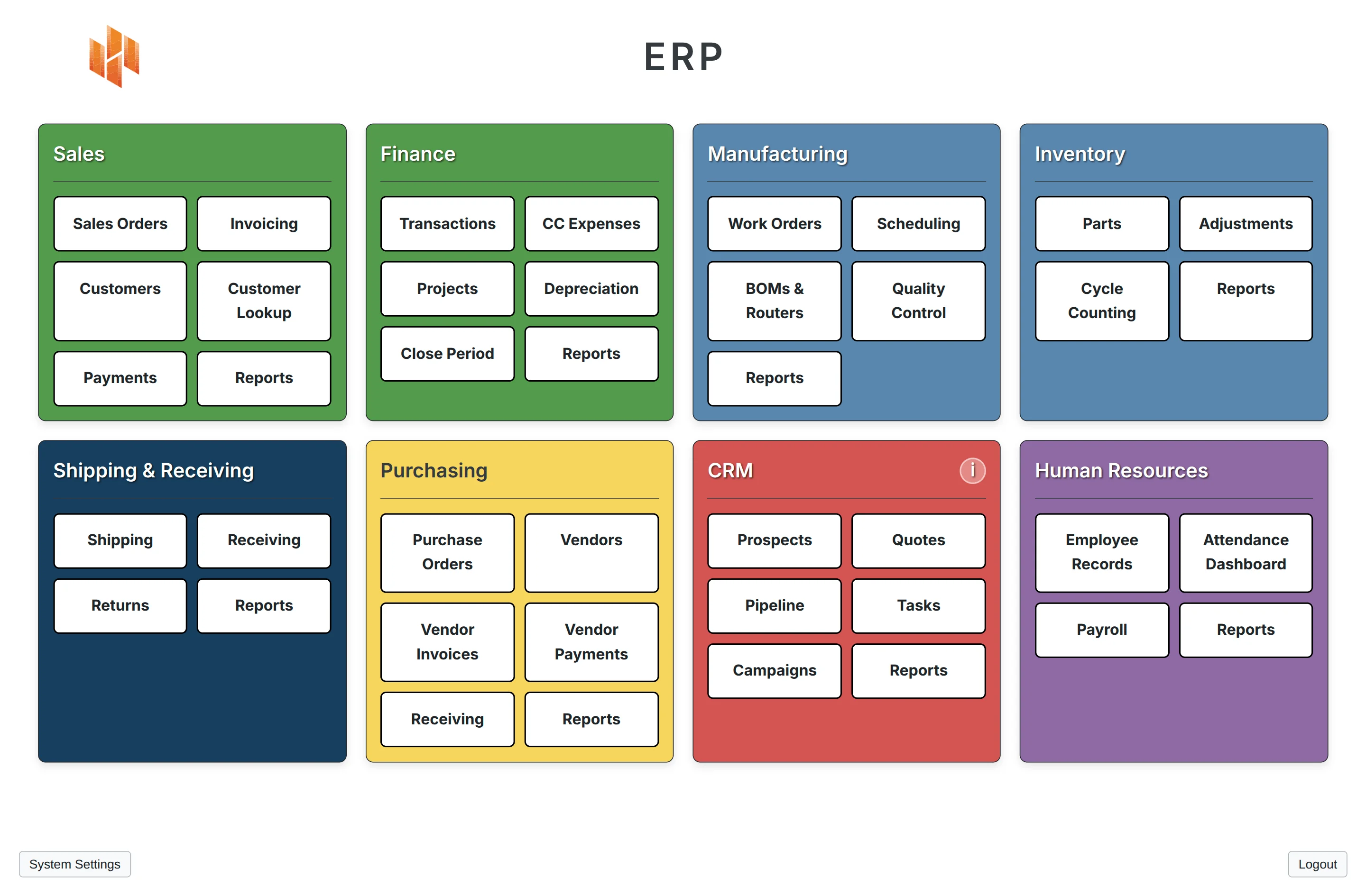
If you want to know exactly where PAX stands for your specific operation, the most useful thing is to get in touch. Don't worry, we'd rather tell you we're not the right fit than make a sale.
The Real Costs Nobody Mentions
Whatever platform you're evaluating, watch for these items that often don't appear in the headline number:
Implementation fees. For anything beyond entry-level tools, expect $5,000 to $100,000 depending on complexity. MRPeasy and Cetec are rare in having genuinely low or no implementation costs for standard deployments. For a breakdown of where implementation money actually goes (services, customization, data migration, integrations, training) and what drives the number up or down, see our guide to manufacturing ERP implementation cost.
Training. Most vendors charge separately for training. Initial training often costs $1,000 to $2,500 per user, plus budget 10% to 15% of your first-year software cost for ongoing annual training.
Data migration. Getting your existing customer records, BOMs, inventory, and financial history into a new system takes time and often costs money. Many vendors bill hourly for migration assistance at $100 to $300 per hour. Ask every vendor upfront what their data migration process looks like and what it costs. In most cases, PAX will handle organizing your data free of charge.
Customization. If you need something the standard system doesn't do, you pay. For some vendors, custom development runs $150 to $300 per hour. For others (like our original ERP), the minimum quote for any customization was $6,000.
Annual increases. Some vendors treat year-one pricing as a promotional rate and raise it at renewal. Ask for multi-year pricing commitments in writing before you sign.
What to Take from This
The short version: a legitimate cloud manufacturing ERP for a small operation now runs $200 to $2,000 per month depending on the system and your user count. Ten years ago, that same capability would have required a six-figure capital investment. The market has genuinely changed.
What hasn't changed is that picking the wrong system still hurts. The monthly fee is rarely the painful part. The painful part is two years later when you're locked into a slow system that doesn't match how you actually manufacture things, every workaround creates two new problems, and nobody trusts the numbers enough to make decisions.
The goal of this post is to give you enough information to have a some conversation with vendors, including us, without going in blind. If you have questions about how any of these platforms compare for your specific situation, we're always happy to talk through it.
Written by
Matthew Obey
March 5, 2026
Have any questions about your ERP options?
We're happy to have conversations with you to get you closer to the right system.