Sales Tax for Small Manufacturers: What to Know
The United States has over 12,000 sales tax jurisdictions. Rates are set by stacking state, county, city, and special district taxes on top of each other. Two addresses on the same street can have different combined rates if one falls inside a Transportation Benefit District and the other doesn't.
Most small manufacturers deal with sales tax every day, but the details—especially around nexus, exemptions, and multi-state obligations—are confusing enough that even experienced controllers get tripped up. This post covers what actually matters: how rates work, what creates a collection obligation, which manufacturing exemptions you might be missing, what automation tools cost, and how to stay on the right side of compliance without overspending.
Destination-Based vs. Origin-Based: Which Rate Do You Charge?
This is the first thing every manufacturer needs to understand. In origin-based states, you charge the tax rate at your own location regardless of where the customer is. In destination-based states, you charge the rate at the customer's ship-to address. The majority of states use destination-based sourcing, and the trend is moving in that direction (New Mexico switched in 2021, Colorado in 2022).
For interstate sales, every state uses destination-based sourcing. If you have a tax obligation in the state where your customer receives the goods, you charge that customer's local rate. Your ship-from location is irrelevant.
In practice, this means a manufacturer in a destination-based state shipping to 30 different customer addresses within their own state may need 30 different tax rates. Even within a single county, incorporated cities and unincorporated areas often have different rates, sometimes by a full percentage point or more.
Your state's Department of Revenue website will tell you whether you're in an origin-based or destination-based state. If you're destination-based, you need a reliable way to look up the rate for every ship-to address on every order.
Nexus: What Creates Your Obligation to Collect
You only need to collect sales tax in states where you have "nexus," a legal connection that creates a collection obligation. There are two types.
Physical nexus is triggered by having a warehouse, office, employee (including remote workers in many states), equipment, or inventory in a state. Sales rep visits create nexus in most states. Even attending a trade show can trigger it in some.
Economic nexus was established by the 2018 South Dakota v. Wayfair Supreme Court decision. All 45 sales tax states now have economic nexus laws. The most common threshold is $100,000 in gross sales into a state within a calendar year. A few states set theirs higher. About 17 states still include an alternative 200-transaction trigger, but the trend is toward dropping the transaction test.
An important nuance: most states calculate the threshold using gross sales, which includes exempt sales and sales for resale. A manufacturer doing $100,000 in wholesale business to a state—even if none of it is actually taxable—can still trigger economic nexus and be required to register.
Nexus is determined per state, based on your sales into that specific state, not your total revenue. If you ship to several states but only exceed the threshold in two of them, you only need to register and collect in those two (plus your home state). Reviewing your sales by state against each state's threshold is straightforward and worth doing at least once a year.
Manufacturing Exemptions: What You're Probably Overpaying On
This is where manufacturers leave the most money on the table. Most states offer significant sales tax exemptions on manufacturing inputs, but the rules vary enough that many manufacturers either don't claim what they're entitled to or claim incorrectly.
Raw materials that become part of the finished product are exempt in nearly every state through resale certificates. This is well understood.
Machinery and equipment used directly in manufacturing is exempt in most states, but not all. The specifics depend on your state: some require the equipment to have a useful life over one year, some require it to be used more than 50% of the time in qualifying manufacturing activities, and states differ on what counts as "directly used in manufacturing" versus general facility equipment.
Consumables (lubricants, welding gases, chemicals used in production) are where it gets complicated. Some states exempt them fully, some partially, some not at all. The distinction often comes down to whether the state follows a broad standard (items necessary to the manufacturing process qualify) or a narrow one (only items that physically or chemically change the product qualify).
Utilities are the sleeper exemption. Several states offer partial or full exemptions on electricity and gas used in manufacturing, with varying thresholds for how much of your usage must be production-related. If your electricity bill runs $8,000/month and you're in a state with a utility exemption you haven't claimed, that could be $5,000 to $8,000 per year in recoverable overpayments.
If you haven't had a sales tax review of your manufacturing inputs in the last few years, it's worth asking your CPA or a sales tax consultant to look at what you're paying tax on versus what's actually exempt in your state.
Exemption Certificates: The #1 Audit Finding
When you sell to a customer who claims tax exemption (a reseller, a government entity, a nonprofit), you need a valid exemption certificate on file. Missing or invalid certificates are the single most common finding in sales tax audits.
Your customer provides a completed certificate (either a state-specific form or the multi-state MTC Uniform Certificate accepted by about 36 states). You keep it on file. If audited, you produce it. If you can't, you owe the tax that should have been collected, plus penalties and interest.
Certificates expire at different intervals depending on the state. Some never expire. Others expire annually, every 3 years, or every 5 years. During an audit, states typically sample a period, calculate the error rate on your certificates, and extrapolate across the full audit window. A few missing certificates from a single quarter can lead to assessments covering years of transactions.
A customer who is exempt in one state is not necessarily exempt in another. You need valid certificates for each state where you make exempt sales.
Filing Requirements and Penalties
States assign filing frequency based on the amount of tax you collect, not your revenue. Most states use a tiered system: monthly filing above a certain annual tax liability, quarterly in the middle range, and annual below a lower threshold. Check your state's DOR website for the specific dollar amounts. Even periods with zero sales require a return. Failure to file a zero-dollar return triggers penalties and, in many states, leaves the statute of limitations open indefinitely for that period.
Penalties for late filing or underpayment typically start at 5% to 10% of tax due and escalate with time. Some states cap penalties at 25% to 50%. Interest accrues on top. For extended non-compliance discovered in audit, penalties and interest can add roughly 30% or more to the base tax owed.
Sales tax is a trust fund tax in most states, meaning you collected it from your customers on behalf of the state. Many states treat unremitted sales tax more seriously than other business debts, and responsible persons in the business can face personal liability depending on state law. If you're unsure about your obligations, a conversation with your CPA is a good starting point.
What Automation Costs
Most ERP systems don't include sales tax automation. They integrate with third-party tools. Here's what those tools cost as of early 2026:
| Solution | Best For | Starting Cost | What's Included | What's Extra |
|---|---|---|---|---|
| Avalara AvaTax | Mid-market, multi-state | ~$50 to $500+/mo (SMB); ~$18,000/yr median for mid-market (per Vendr contract data) | Rate calculation across 12,000+ jurisdictions. Real-time address-level geocoding. | Filing ($42 to $54 per state per filing period). Exemption cert management. Registration ($403/state). Each module priced separately. Implementation adds thousands in year one. |
| Vertex O Series | Enterprise | $1,500+/mo | Comprehensive calculation, returns, exemption management. | Enterprise pricing, enterprise complexity. |
| TaxJar (Stripe) | Ecommerce, SMB | ~$19/mo basic | Calculation, nexus tracking, AutoFile. | Built for online sellers. Limited ERP integration for manufacturing workflows. Overage fees beyond plan limits. |
| Zamp | SMB | $199/mo | Managed compliance. | Relatively new. Monthly cost adds up for basic needs. |
| TaxCloud | SMB (eligible) | Free tier available | Sales tax reporting, calculation, SST discounts, and filing add-ons. | All states are included, but free SST services are limited to the 24 member states. Paid filing and services apply elsewhere. |
The pricing gap between the free/cheap tier and full-featured platforms reflects a real difference in scope. Avalara covers product taxability rules, district-level geocoding, multi-state filing and remittance, exemption certificate document management, and nexus monitoring. If you're collecting in 10+ states with varying product taxability rules, that level of automation has a clear ROI.
If you're a manufacturer selling primarily within one or two states and your products are uniformly taxable, the core problem is simpler: getting the right rate on every order and keeping a clean record of what was charged and why.
How PAX Handles It
We built basic sales tax calculation directly into PAX because our team was manually looking up rates on the Department of Revenue website for every sales order.
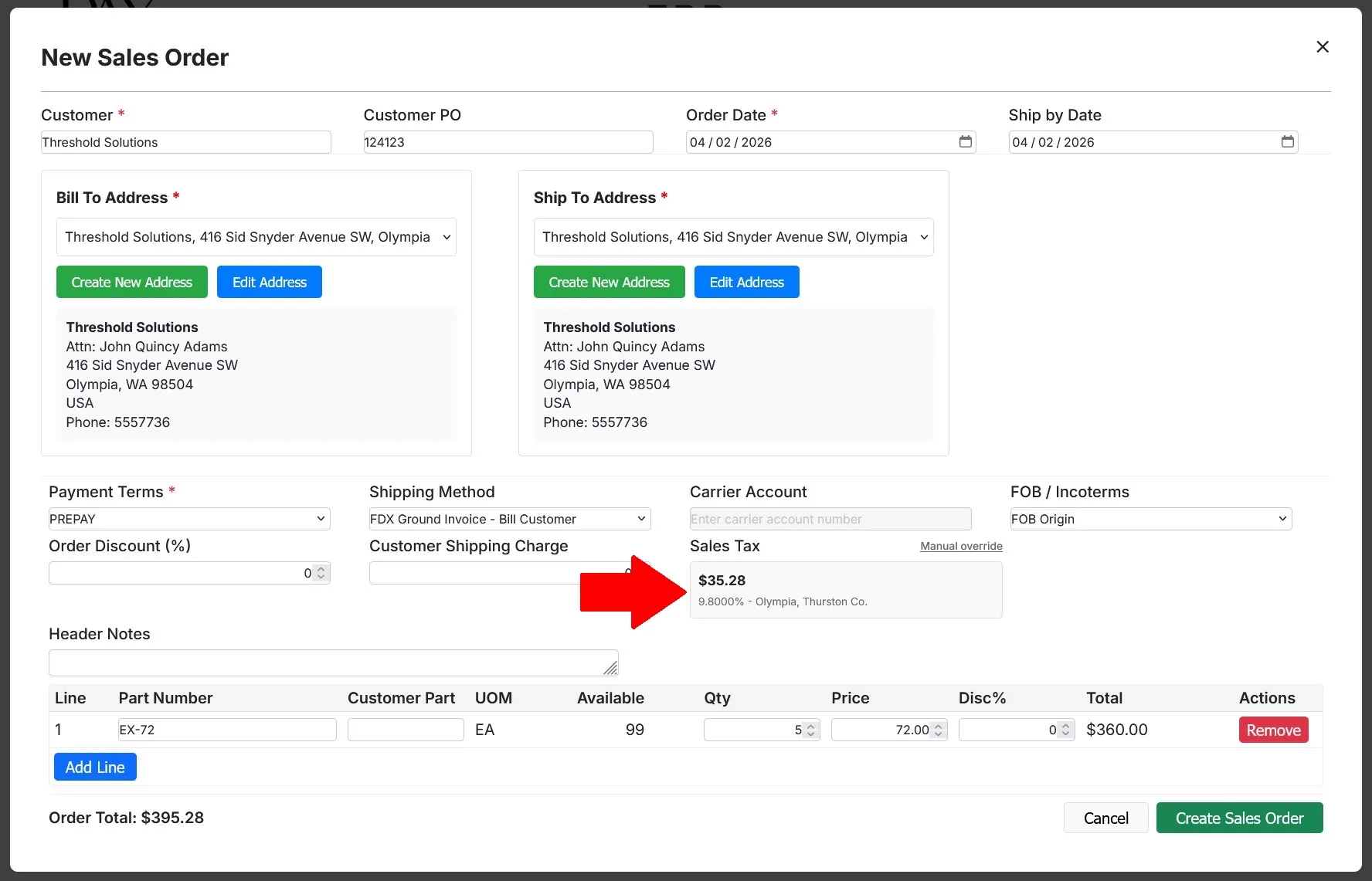
When a CSR selects a ship-to address, PAX looks up the applicable rate from its internal tax rate table, calculates the tax, and displays the rate, jurisdiction, and county. Tax exemptions are handled at two levels: per customer (blanket exemption) or per specific ship-to address. A manual override toggle handles edge cases where the auto-calculated amount needs adjustment.
Rate updates come directly from state-published files. States generally publish their rate tables quarterly in standard formats (.xlsx, .csv). An admin downloads the file from the state's DOR website, uploads it in PAX under Settings, selects the state and effective date, and the system imports the full set of rates in one step. No reformatting, no middleware, no manual data entry. The file goes in exactly as the state published it. Previous quarter rates are preserved automatically for audit history. The whole process takes about two minutes per state per quarter.
Where this falls short. We add support for new states as our customers request them, so coverage is expanding but not yet nationwide. Rate imports are manual (someone needs to remember to upload the new file each quarter). Address matching uses city name and county lookup rather than full geocoding, so an address at the edge of a jurisdiction boundary could match to the wrong location code in rare cases. There's no product taxability engine (all taxable items are treated the same), and no filing or remittance.
Two features are in active development: a document management system for storing customer exemption certificates with automatic expiration notifications, and nexus monitoring to flag when your sales into a state approach the collection threshold.
For a manufacturer whose main pain point is getting the right rate on every order without a manual DOR lookup, two minutes of quarterly uploads is a reasonable trade against $6,000+ per year in third-party automation costs. For manufacturers collecting in many states with complex product taxability, a dedicated platform is the right tool.
Where to Start
If you're shipping to multiple states and haven't reviewed your nexus obligations recently, that's the place to begin. Pull your sales by state for the past year, compare each state's total against that state's economic nexus threshold (usually $100,000, though a few are higher), and determine where you have a collection obligation. Your state's Department of Revenue website will have the threshold and registration process.
For a broader look at what ERP systems cost and how sales tax fits into the total picture, see our pricing breakdown. If you want to see how PAX handles tax calculation for your specific operation, reach out.
Written by
Matthew Obey
April 2, 2026