Before You Quote That Job Again, Check What It Actually Cost
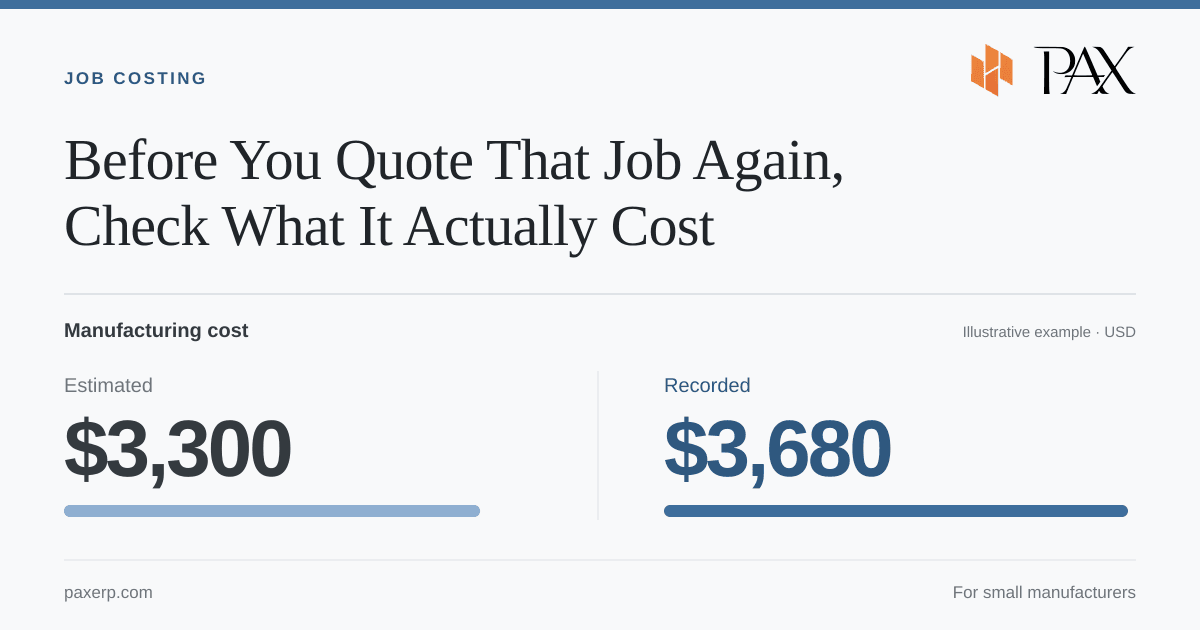
A customer wants another 100 assemblies at the same $50 price. The previous quote allowed $3,300 in manufacturing costs. The finished job came in at $3,680.
In this illustrative example, the order was completed and sold, all supplier bills and labor were recorded, and nothing changed in the quantity or selling price. The extra $380 came from work and charges the estimate missed.
At $5,000 in revenue, the expected $1,700 gross profit became $1,320. Manufacturing gross margin went from 34% to 26.4%.
Whether the next order should carry the same $3,680 cost depends on what happened during the first one.
Where the difference came from
| Manufacturing cost | Estimated | Recorded | Difference |
|---|---|---|---|
| Components | $2,000 | $2,100 | +$100 |
| Direct labor | $600 | $720 | +$120 |
| Outside finishing | $400 | $500 | +$100 |
| Applied manufacturing overhead | $300 | $360 | +$60 |
| Total | $3,300 | $3,680 | +$380 |
The job used 200 components at $10.50 each. The estimate still had them at $10. Finishing was estimated at $400, below the supplier's $500 minimum batch charge.
The labor estimate allowed four hours of setup and 16 hours of assembly. Assembly went as expected. Setup took six hours, and inspection added another two hours that weren't in the quote. At $30 per labor hour, that brought labor from $600 to $720.
This shop applies manufacturing overhead at $15 per job-labor hour, adding $60 for those four extra hours. That's an allocation of indirect production costs, rather than another supplier bill. The labor and overhead rates cover separate costs; neither includes the finishing charge.
What carries into the next order
The component price and finishing minimum account for $200 of the difference. Assuming the suppliers confirm those prices for the repeat order, both belong in the new estimate.
Inspection accounts for another $90: $60 in labor and $30 in applied overhead. If the same inspection is required for every batch, the original quote was short by two hours.
The remaining $90 comes from the two additional setup hours.
Suppose those hours went into modifying a fixture on the first run. The fixture is now ready for the repeat order, and the person doing the setup expects to be back at four hours. The next batch would then have an estimated manufacturing cost of $3,590, including the updated material price, finishing minimum, and inspection.
If six hours is what the setup actually takes each time, $3,680 is the better forecast. A setup improvement might reduce that later, once it has been tried and timed.
What that does to the price
At the old $50 price, the $3,590 forecast leaves a 28.2% manufacturing gross margin. The $3,680 forecast leaves 26.4%.
If the owner chooses to retain the original 34% margin, the price for the higher-cost case is:
$3,680 ÷ (1 − 0.34) ÷ 100 = $55.76 per assembly, rounded up to the nearest cent.
With the one-time fixture work excluded, the same calculation on $3,590 gives $54.40 per assembly, rounded up. Both prices assume another 100-piece order with the same requirements. A smaller batch would spread the setup and finishing minimum across fewer pieces.
The 34% margin is just the target chosen for this example. Selling, administrative, financing, and tax costs sit outside the manufacturing costs shown here. Period-end overhead adjustments can also change the reported gross margin.
The revised estimate
With four setup hours, the revised estimate has 200 components at $10.50, 16 assembly hours, two inspection hours, and a $500 finishing minimum. Labor is $660 and applied overhead is $330. Total: $3,590.
The note beside setup is specific: “First run included two hours modifying the fixture. Repeat setup estimated at four hours.”
Figures are in US dollars, with no discounts, returns, or freight charges. Recorded job cost combines direct costs with applied manufacturing overhead. Background: applying manufacturing overhead and job-order costing.